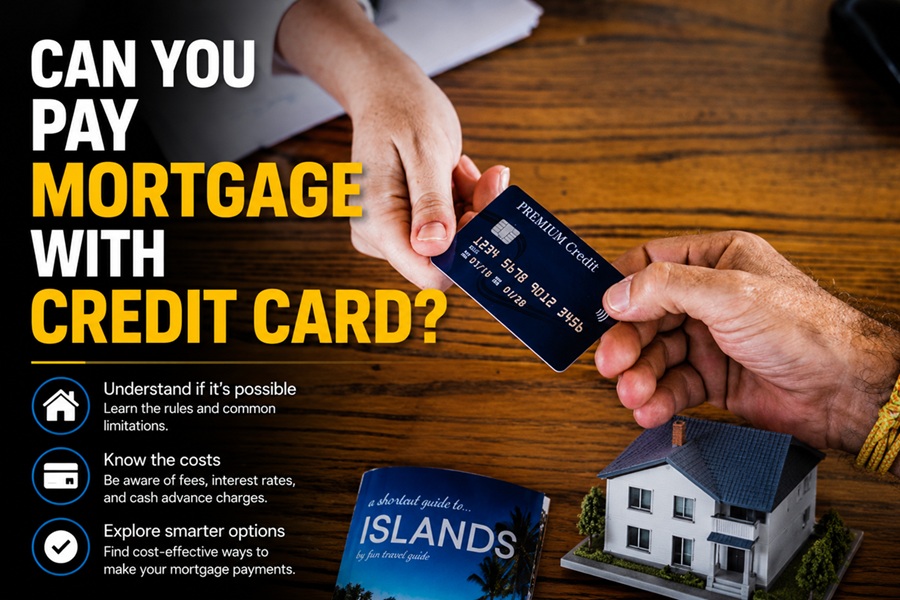
In most cases, you cannot pay your mortgage directly with a credit card, because the vast majority of mortgage lenders simply do not accept card payments. You can, however, do it indirectly through a third-party payment service that charges a processing fee, usually around 2.9 percent, or through workarounds like buying a money order. For most people, those fees cancel out any rewards, so it is rarely worth doing.
The reason lenders avoid credit cards comes down to cost and risk. Card networks charge merchants a fee on every transaction, and paying one debt with another form of debt makes lenders uneasy. So while the answer is technically yes with some effort, the real question is whether the effort and expense make any sense for your situation.
| Question | Can you pay a mortgage with a credit card? |
| Direct payment | Almost never accepted by lenders |
| Indirect method | Third-party payment services for a fee |
| Typical fee | Around 2.9 percent per transaction |
| Accepted networks | Often Discover and Mastercard, not Visa or Amex |
| Main downside | Fees usually outweigh any rewards earned |
| Risk | Turning secured debt into costly credit card debt |
| Usually worth it? | Rarely, except in specific edge cases |
Why Lenders Do Not Accept Credit Cards
Mortgage lenders steer clear of card payments for practical reasons. Every card transaction carries a processing fee that someone has to absorb, and lenders are not willing to eat that cost on payments as large as a mortgage. Passing it to you would also raise legal and logistical headaches.
There is a deeper reason too. Paying one debt with another is exactly the kind of behaviour lenders want to discourage. Letting borrowers charge mortgage payments to a credit card could mask financial trouble and increase the risk of default, so the whole system is set up to avoid it.
Using a Third-Party Payment Service
The main way people manage to pay a mortgage with a card is through a third-party service that acts as a middleman. You pay the service with your credit card, and it sends real money, by check or bank transfer, to your lender on your behalf. The lender receives cash, while the charge lands on your card.
The catch is the fee. These services typically charge close to 2.9 percent per transaction, which adds up fast on a large mortgage payment. They also tend to restrict which card networks work, often accepting Discover and Mastercard while excluding Visa and American Express. Always confirm the details before relying on this route.
| Consideration | What to Know |
| Processing fee | Around 2.9 percent of each payment |
| Accepted cards | Often limited to certain networks |
| Payment method | Service sends a check or transfer to the lender |
| Rewards | Only worthwhile if they exceed the fee |
| Approval | Lender and card issuer must both allow it |
Other Workarounds
Beyond dedicated services, a few other methods let you turn credit into a mortgage payment, though each has drawbacks. These tend to be more trouble than they are worth, but it helps to know they exist.
- Buying a money order with a card, though fewer retailers now allow it
- Taking a cash advance, which carries high fees and interest from day one
- Using a balance transfer or card loan feature offered by some issuers
- Certain niche cards that reward housing payments without a direct charge
When It Might Actually Make Sense
Despite the costs, there are narrow situations where paying by card can be reasonable. These are exceptions rather than the rule, and each still deserves careful maths before you commit.
- Earning a large sign-up bonus worth more than the fees paid
- Avoiding foreclosure when you have no other funds available short term
- Using a short grace period to bridge a genuine timing gap
- Meeting a spending threshold that unlocks meaningful rewards
The Risks You Should Weigh
Charging a mortgage to a credit card can quietly create serious problems. The biggest danger is converting your mortgage, a relatively low-interest secured debt, into high-interest credit card debt if you cannot clear the balance. That swap can cost you dearly over time.
There are other pitfalls too. Large charges can spike your credit utilisation and dent your credit score, some issuers treat these payments as cash advances with instant interest, and the fees erode any rewards. If paying by card signals that you cannot afford the mortgage, that is a sign to seek help, not to reach for plastic.
| Risk | Why It Matters |
| High-interest debt | Credit card rates far exceed mortgage rates |
| Credit score impact | Large balances raise utilisation |
| Cash advance coding | Some payments trigger immediate interest |
| Fees erode rewards | The 2.9 percent charge often wins |
How the Process Works Step by Step
If you do decide to use a third-party service, the process itself is fairly straightforward. Understanding the flow helps you see exactly where the fee comes in and why the lender never touches your card directly.
- You enter your mortgage details and payment amount into the service
- You pay the service using your eligible credit card
- The service adds its processing fee to the transaction
- It then sends a check or bank transfer to your lender
- You repay your credit card balance, ideally before interest accrues
The whole point is that the lender receives ordinary money while your card carries the charge. As long as you clear the card balance quickly, you avoid interest, though the processing fee remains unavoidable.
Understanding the Cash Advance Trap
Some people try to sidestep third-party fees by taking a cash advance and using that money for the mortgage. This is usually a costly mistake. Cash advances typically begin charging interest immediately, with no grace period, and often at a higher rate than normal purchases.
On top of that, most cards charge a separate cash advance fee upfront. Between the instant interest and the fee, this route frequently costs more than a dedicated payment service. It is best avoided unless you have no other option and can repay almost instantly.
Weighing Rewards Against Fees
The dream scenario for many is charging a mortgage to earn generous rewards. The maths rarely works, though. With a processing fee near 2.9 percent and typical rewards closer to 1 or 2 percent, you usually end up behind before you even start.
The exception is a large welcome bonus. If putting a mortgage payment on a new card helps you hit a spending threshold that unlocks a bonus worth far more than the fee, the trade can pay off once. Outside that specific case, the fee almost always swallows the reward.
Check All Three Parties First
Even when a workaround seems available, it can fail at the last moment unless everyone involved agrees to it. Three separate parties each have a say, and any one of them can block the payment. Confirming with all of them before you rely on the method saves you from a nasty surprise.
Some card issuers refuse mortgage payments outright, some mortgage lenders will not accept third-party payments, and certain card networks are excluded by the payment services. A declined or late mortgage payment can carry real consequences, so a few quick phone calls beforehand are well worth the effort.
Better Alternatives to Consider
If you are reaching for a credit card because money is tight, there are healthier options. Lenders often prefer to work with borrowers rather than see them fall behind, so it is worth having an honest conversation before turning to expensive workarounds.
- Ask your lender about forbearance or a temporary payment pause
- Explore a loan modification to adjust your terms
- Consider refinancing if it lowers your monthly payment
- Look into a personal loan, which usually costs less than card debt
- Build an emergency fund to avoid the squeeze next time
Frequently Asked Questions
Can I pay my mortgage directly with a credit card?
Almost never. The vast majority of mortgage lenders do not accept credit cards, so you would need a third-party service or workaround to do it indirectly.
How much does it cost to pay a mortgage with a credit card?
Third-party services typically charge around 2.9 percent per transaction, which can add tens or hundreds of dollars to each mortgage payment depending on its size.
Is it worth paying a mortgage with a credit card for rewards?
Usually not. The processing fee generally exceeds the value of the rewards earned, so you tend to lose money unless you are chasing a large sign-up bonus.
Which credit cards can be used through these services?
It varies, but many third-party services accept Discover and Mastercard while excluding Visa and American Express. Always check before relying on your card.
Could paying by card hurt my credit score?
It can. A large charge raises your credit utilisation, which may lower your score, especially if you carry the balance rather than paying it off quickly.