

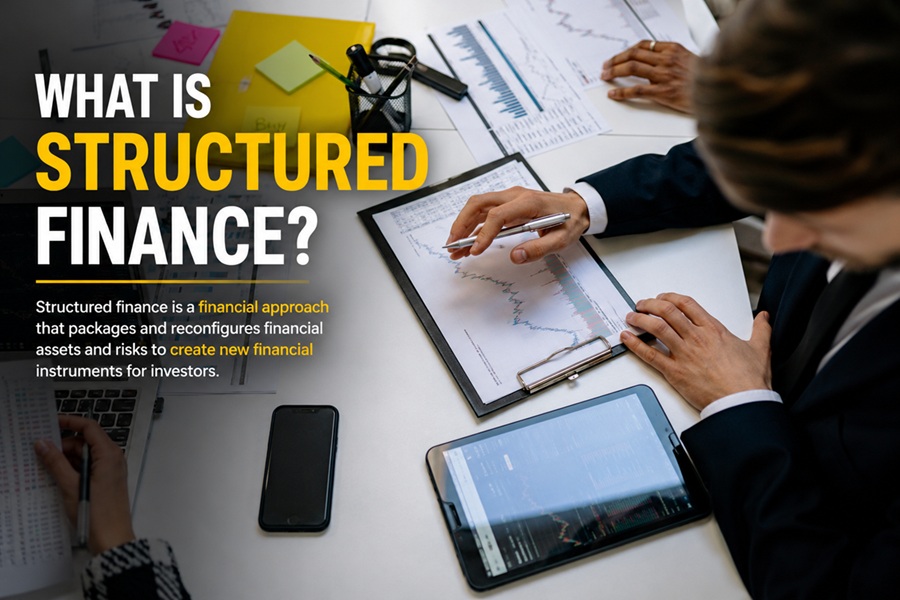
Structured finance is a specialised area of finance that manages risk and raises large amounts of capital by pooling financial assets and repackaging them into new securities that investors can buy. In plain terms, it takes many individual loans or income streams, bundles them together, and turns them into tradable products. It exists to solve funding needs too big or too complex for a standard loan.
This branch of finance is used mainly by large corporations, banks, and institutions rather than everyday consumers. When an organisation needs financing that ordinary borrowing cannot provide, structured finance offers custom-built solutions tailored to the situation. The trade-off is complexity, since these arrangements involve intricate structures and specialist knowledge that most people never see behind the scenes.
| Term | Structured Finance |
| Category | Corporate and institutional finance |
| Core purpose | Managing risk and raising large-scale capital |
| Key mechanism | Pooling assets and repackaging them as securities |
| Main users | Banks, corporations, and large institutions |
| Common instruments | ABS, MBS, CDOs, and securitised products |
| Key benefit | Access to funding beyond ordinary loans |
| Key risk | Complexity and hidden concentrations of risk |
How Structured Finance Works
At its heart, structured finance relies on a process called securitisation. A financial institution gathers a large pool of assets that generate cash, such as mortgages, car loans, or credit card receivables. Those assets are then bundled together and used to back new securities that are sold to investors.
Investors who buy these securities receive payments funded by the underlying assets. The pooled loans, in effect, become the engine that pays returns. This lets the original lender free up capital and shift some risk to investors, while giving those investors a new way to earn income.
The Building Blocks
Structured finance produces several types of instruments, each built from different underlying assets. While the names sound technical, the idea behind each is broadly similar: pool assets, then sell claims on their cash flows.
| Instrument | What Backs It |
| Asset-backed securities (ABS) | Pools of loans like car or credit card debt |
| Mortgage-backed securities (MBS) | Pools of home mortgages |
| Collateralised debt obligations (CDO) | A mix of debt instruments in tranches |
| Collateralised loan obligations (CLO) | Pools of corporate loans |
| Securitised receivables | Future income streams turned into securities |
The Role of Tranches
One defining feature of structured finance is the use of tranches, which are layers of risk within the same deal. The pooled income is split into slices that carry different levels of risk and reward. Safer tranches get paid first and offer lower returns, while riskier tranches get paid last but promise higher yields.
This layering lets a single pool of assets serve very different investors. A cautious pension fund might buy the safest slice, while an investor hunting bigger returns takes on a riskier one. Tailoring risk this precisely is a big part of what makes structured finance so flexible.
Who Uses Structured Finance and Why
The main users are institutions with large, specialised funding needs. A bank might use it to offload loans from its books and lend more, while a corporation might use it to raise capital against future revenues. The common thread is scale and complexity that ordinary finance cannot handle.
- Banks freeing up capital by selling off pooled loans
- Corporations raising money against predictable income streams
- Investors seeking tailored risk and return profiles
- Institutions financing large projects or asset portfolios
The Benefits
When used carefully, structured finance offers real advantages to the parties involved. It expands access to capital and spreads risk in ways that traditional lending cannot match. These strengths explain why it remains a core tool in modern finance.
| Benefit | Explanation |
| More capital access | Unlocks funding beyond standard loans |
| Risk distribution | Spreads risk across many investors |
| Improved liquidity | Turns illiquid loans into tradable securities |
| Customisation | Structures tailored to specific needs |
The Risks and Lessons
For all its usefulness, structured finance carries serious risks, mostly rooted in its complexity. When products become so intricate that even experts struggle to see the underlying risk, trouble can build unnoticed. The layers that spread risk can also hide it.
The 2008 financial crisis is the clearest warning. Complex mortgage-backed securities and related products bundled risky loans in ways that obscured how fragile they were. When those loans failed, the damage spread widely. The episode taught the industry that transparency and careful risk assessment are not optional in structured finance.
Structured Finance Versus Traditional Finance
The clearest way to grasp structured finance is to compare it with ordinary borrowing. A traditional loan is simple: one lender gives money to one borrower, who repays it over time. Structured finance rearranges this into something far more elaborate, involving pooled assets, multiple investors, and layers of risk.
This complexity is not complexity for its own sake. It exists to solve problems that plain loans cannot, such as funding on a massive scale or precisely distributing risk. The trade-off is that structured deals are harder to understand and require specialist expertise to manage well.
| Traditional Finance | Structured Finance |
| One lender, one borrower | Pooled assets, many investors |
| Simple, transparent terms | Complex, layered structures |
| Fixed risk with the lender | Risk spread across tranches |
| Standard loans | Custom-built securities |
The Role of Credit Ratings
Because investors cannot easily assess pools of thousands of loans themselves, credit rating agencies play a central role in structured finance. They evaluate the securities and assign ratings that signal how risky each one is. Investors lean heavily on these ratings when deciding what to buy.
This reliance is also a vulnerability. If ratings are too optimistic, investors may take on far more risk than they realise. Part of what went wrong in 2008 was that some highly rated products turned out to be much riskier than their ratings suggested, shaking trust in the whole system.
How Structured Finance Creates Value
When it works well, structured finance benefits everyone in the chain. Lenders convert slow-paying loans into immediate cash, freeing them to lend again. Investors gain access to income streams they could never reach individually. And borrowers, indirectly, benefit from a financial system with more capital to lend.
This circulation of capital is a quiet engine of the modern economy. By turning illiquid assets into tradable securities, structured finance keeps money moving, which supports lending for homes, cars, businesses, and large projects across the economy.
A Brief History and Rise
Structured finance grew steadily through the late twentieth century as institutions searched for smarter ways to fund lending and manage risk. Mortgage-backed securities were among the earliest widely used forms, letting banks turn home loans into investments and recycle their capital into new lending.
Over the following decades, the field expanded to cover many kinds of assets, from car loans to credit card balances to corporate debt. This growth brought enormous efficiency to financial markets, but it also introduced complexity that, when poorly managed, could magnify problems rather than contain them.
Why It Still Matters Today
Despite the lessons of past crises, structured finance remains a vital part of the global economy. Reforms have improved transparency and oversight, and the core function it serves, moving capital efficiently and distributing risk, is genuinely useful when handled responsibly.
For anyone studying finance or business, understanding this field offers insight into how modern markets actually work. Much of the lending that fuels homes, businesses, and consumer spending relies on these behind-the-scenes structures, even if most people never encounter them directly.
Structured Finance in Simple Terms
If the jargon feels overwhelming, a simple analogy helps. Imagine a lender with thousands of small loans. Rather than waiting years to collect on each, it bundles them into a package and sells shares of that package to investors, who then collect the repayments. The lender gets cash now, and investors get a steady income stream.
That basic idea, converting future payments into upfront capital while sharing the risk, sits at the core of every structured finance product, no matter how complicated the wrapping looks.
Frequently Asked Questions
What is structured finance in simple words?
It is a way of pooling many loans or income streams and repackaging them into securities that investors can buy, used to raise large amounts of capital and manage risk.
Who uses structured finance?
Mainly banks, large corporations, and institutional investors with funding needs too big or complex for ordinary loans, rather than everyday consumers.
Is structured finance risky?
It can be. Its complexity can hide concentrations of risk, as seen in the 2008 crisis, which is why transparency and careful analysis are so important.
What is securitisation?
Securitisation is the process of pooling assets like loans and turning them into tradable securities, and it is the foundation of most structured finance products.
What are tranches?
Tranches are layers within a structured product that carry different levels of risk and return, allowing one asset pool to serve investors with different appetites for risk. Safer tranches are paid first and yield less, while riskier tranches are paid last but offer higher potential returns.