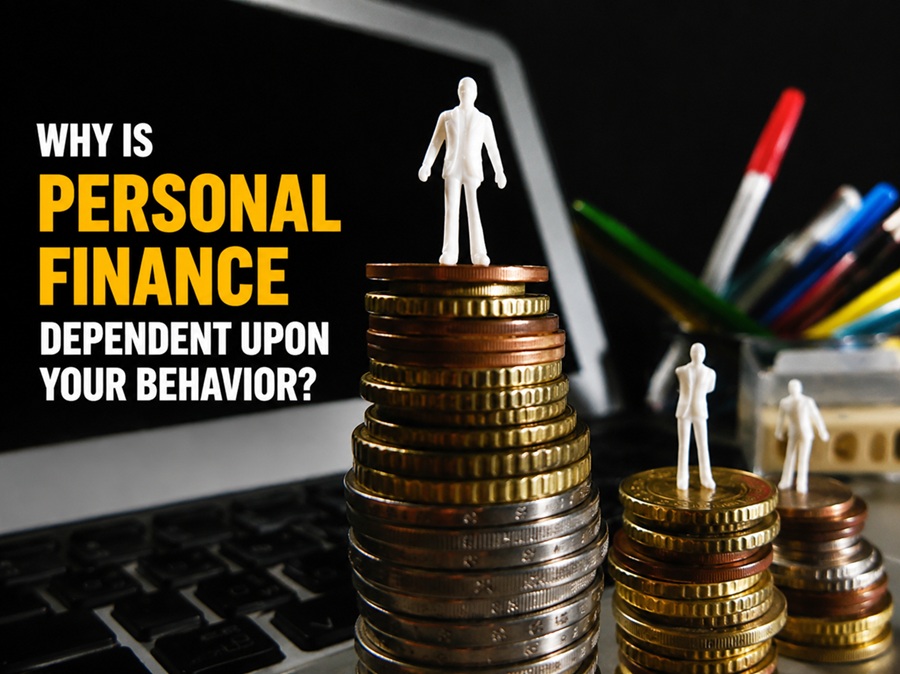
Personal finance depends heavily on your behavior because managing money successfully is far more about your daily habits and choices than about how much you know. You can understand every rule of budgeting and investing, but your actual financial results come from what you do with money, how you spend, save, and resist impulses. Knowledge sets the direction, yet behavior determines where you actually end up.
This is why two people with the same income and the same information can end up in completely different financial situations. One builds savings and stays out of debt, while the other struggles paycheck to paycheck. The difference is rarely intelligence or knowledge. It comes down to consistent behavior, the small decisions repeated day after day that quietly shape a financial life.
| Topic | Behavior and personal finance |
| Category | Personal finance and money habits |
| Core idea | Habits matter more than knowledge |
| Key behaviors | Spending, saving, budgeting, self-control |
| Emotional factors | Impulse, fear, comfort, social pressure |
| Main insight | Consistent actions shape long-term outcomes |
| Good news | Behavior can be learned and improved |
Knowledge Versus Behavior
Financial knowledge is useful, but it is not the deciding factor in most people’s money lives. Plenty of people know they should spend less than they earn, yet do the opposite. The gap between knowing and doing is where personal finance is truly won or lost.
Think of it like health. Almost everyone knows that eating well and exercising leads to better health, but knowing does not make it happen. The same is true with money. Understanding compound interest means little if you never actually save. Behavior turns knowledge into results.
The Behaviors That Shape Your Finances
A handful of everyday behaviors do most of the heavy lifting when it comes to financial outcomes. None of them require advanced knowledge, yet each has an outsized effect over time.
| Behavior | Effect on Your Finances |
| Spending less than you earn | Builds savings and avoids debt |
| Saving consistently | Creates a cushion and grows wealth |
| Avoiding impulse purchases | Keeps money aligned with priorities |
| Paying bills on time | Protects credit and avoids fees |
| Sticking to a budget | Gives spending structure and control |
| Investing regularly | Lets money grow over the long term |
The Emotional Side of Money
Money decisions are rarely purely logical. Emotions play an enormous role, often pushing people to act against their own best interests. Fear, excitement, boredom, and stress can all trigger spending or saving decisions that a spreadsheet would never recommend.
Consider how a stressful day can lead to retail therapy, or how social pressure nudges people to spend beyond their means to keep up with others. Recognising these emotional triggers is the first step to managing them. The most financially successful people are not emotionless. They have simply learned to pause before emotion drives their money.
Common Behavioral Traps
Certain patterns of behavior trip people up again and again. Spotting them in your own life makes them easier to avoid. Each of these habits chips away at financial health, often without the person noticing.
- Lifestyle inflation, spending more every time income rises
- Impulse buying driven by emotion rather than need
- Ignoring small recurring costs that quietly add up
- Putting off saving until some vague future date
- Using debt to fund a lifestyle you cannot yet afford
Why Small Habits Matter So Much
Personal finance is a long game, and small behaviors compound over years. Saving a modest amount each month feels insignificant in isolation, but repeated for decades and paired with investment growth, it can build real wealth. The same is true in reverse, where small overspending habits slowly erode your finances.
This is why behavior beats occasional big decisions. One smart investment cannot rescue years of overspending, and one splurge rarely ruins a disciplined saver. Your financial future is written by the habits you repeat, not the choices you make once in a while.
| Good Habit Repeated | Bad Habit Repeated |
| Steady saving builds wealth | Steady overspending builds debt |
| On-time payments protect credit | Missed payments damage credit |
| Mindful spending grows freedom | Impulse spending shrinks it |
| Regular investing compounds | Delayed investing loses time |
A Tale of Two Savers
Picture two people earning the same salary. The first spends a little less than they make, quietly setting aside money each month without much fuss. The second spends everything, upgrading their lifestyle every time a raise arrives. On paper, their incomes are identical.
Fast forward ten years, and their situations look nothing alike. The first has savings, investments, and options. The second has more possessions but little security and perhaps some debt. Neither knew more than the other about finance. The difference was behavior, repeated quietly over a decade.
The Psychology Behind Spending
Our brains are not wired for long-term financial thinking. We are built to value immediate rewards over distant ones, which is why saving for a far-off goal feels so much harder than buying something now. Understanding this wiring helps explain why good financial behavior takes effort.
Marketing, convenience, and social comparison all exploit these tendencies. One-click purchases remove friction, adverts create desire, and seeing others’ lifestyles fuels the urge to keep up. Recognising that these forces work on everyone makes it easier to resist them and act more deliberately with money.
Small Changes That Shift Behavior
Improving your financial behavior does not require dramatic sacrifice. Often the most effective changes are small tweaks that reduce temptation or make good choices easier. These little adjustments add up to meaningful shifts over time.
- Introduce a waiting period before any non-essential purchase
- Unsubscribe from marketing emails that tempt you to spend
- Keep savings in a separate account that is harder to dip into
- Review your spending weekly to stay honest with yourself
- Celebrate small wins to reinforce good money habits
Teaching Better Money Habits
Because financial behavior is learned, it can also be taught, both to ourselves and to others. Good habits often start young, but they can be built at any age. The key is focusing on actions and routines rather than just piling on information.
Rather than simply telling someone the rules of money, the most effective approach is to help them build habits through practice. Starting a small savings routine, tracking spending together, or setting a shared goal teaches by doing. These lived experiences shape behavior far more deeply than a lecture ever could.
Consistency Beats Intensity
A common trap is believing that dramatic, all-or-nothing effort is what fixes finances. In reality, quiet consistency wins. A person who saves a modest amount every single month will usually outperform someone who makes one grand gesture and then loses momentum.
This is oddly encouraging. You do not need to overhaul your entire life overnight to improve your finances. You simply need to choose one or two better behaviors and repeat them faithfully. Over months and years, that steady repetition does the heavy lifting for you.
How to Improve Your Financial Behavior
The encouraging truth is that behavior can be shaped and improved. You do not need to become a different person overnight. Small, deliberate changes to your habits and environment can steadily steer your finances in a better direction.
- Automate savings so good behavior happens without willpower
- Set clear goals that give your money a purpose
- Track your spending to stay aware of where money goes
- Pause before big purchases to separate want from need
- Remove temptations, like unused subscriptions or shopping apps
Building Systems That Support You
One of the smartest moves is to design systems that make good behavior automatic. When savings leave your account before you can spend them, you no longer rely on discipline in the moment. When bills pay themselves on time, you avoid late fees without effort.
This approach works because it accepts a simple truth: willpower is limited. Rather than fighting your impulses every day, you build an environment where the easy choice is also the wise one. That is how lasting financial habits are formed.
Frequently Asked Questions
Why does behavior matter more than knowledge in personal finance?
Because knowing what to do does not guarantee doing it. Financial results come from consistent actions, so habits and choices shape outcomes more than information alone.
Can financial behavior be changed?
Yes. Behavior can be learned and improved through small, deliberate habits, automation, and systems that make good choices easier and bad ones harder.
How do emotions affect money decisions?
Emotions like stress, fear, and social pressure can drive impulsive spending or poor choices, which is why recognising and managing them is key to financial success.
What is the most important financial behavior?
Consistently spending less than you earn is often the foundation, since it enables saving, investing, and staying out of debt over the long term.
Why do small habits matter so much?
Because they compound over time. Small, repeated actions, good or bad, add up to large financial effects across months and years.