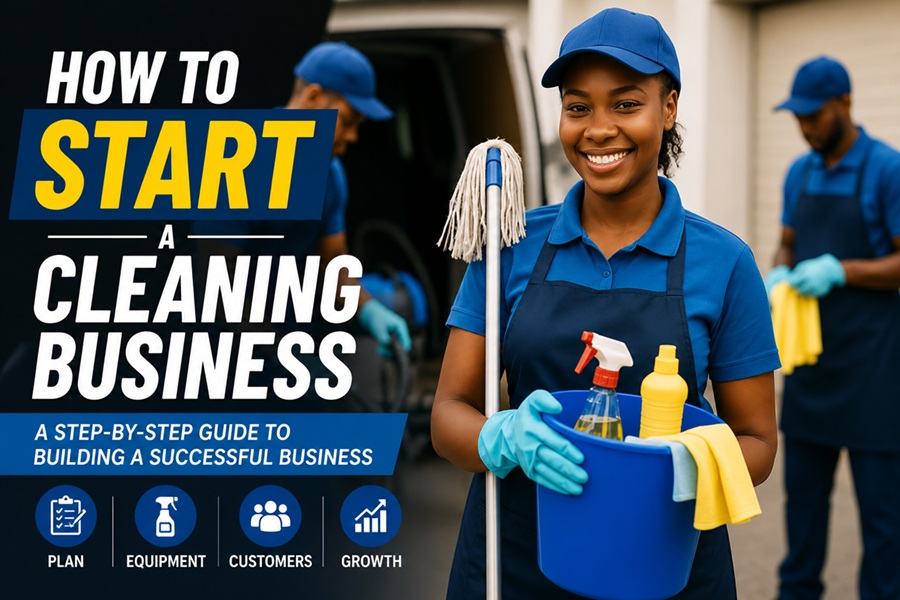
To start a cleaning business, you need to choose your niche, register the business legally, buy basic equipment and supplies, set your prices, and find your first clients. It is one of the most accessible businesses to launch because the startup costs are low, the demand is steady, and you can begin small and grow at your own pace.
A cleaning company does not require a fancy office or a big loan to get off the ground. Many owners start solo with a car, a few supplies, and a handful of local clients, then scale into a team as word spreads. Because homes and businesses always need cleaning, demand rarely dries up, which makes it a resilient choice even in uncertain economic times. What follows is a practical roadmap covering everything from paperwork to pricing to landing those first paying customers.
| Business type | Cleaning services company |
| Startup cost | Low, often a few hundred to a few thousand dollars |
| Common niches | Residential, commercial, deep cleaning, specialty |
| Skills needed | Reliability, attention to detail, basic admin |
| Team size to start | Solo or a small crew |
| Main expenses | Supplies, equipment, insurance, marketing |
| Revenue model | Per job, hourly, or recurring contracts |
| Growth path | Add staff, contracts, and specialty services |
Step 1: Choose Your Cleaning Niche
Cleaning is a broad field, and picking a focus helps you stand out instead of competing with everyone. Each niche has its own customers, pricing, and demands. Some suit a solo starter, while others need equipment or a crew from day one.
| Niche | Typical Clients | Notes |
| Residential | Homeowners, renters | Easy entry, steady repeat work |
| Commercial | Offices, shops | Larger contracts, evening hours |
| Deep cleaning | Move-outs, spring cleans | Higher rates per job |
| Specialty | Carpets, windows, post-build | Needs specific equipment |
Step 2: Register Your Business
Before you take on paying clients, make the business official. This protects you legally, builds trust with customers, and keeps your finances clean. The exact steps vary by location, but the essentials are similar everywhere.
- Pick a business name that is memorable and easy to spell
- Choose a legal structure, such as sole proprietorship or LLC
- Register the business and apply for any required licences
- Get a tax identification number for your area
- Open a separate business bank account
Step 3: Sort Out Insurance
Insurance is not optional in this line of work. You will be inside people’s homes and offices, handling their belongings, so accidents are a real risk. The right coverage protects both you and your clients, and many commercial customers will not hire you without it.
- General liability insurance for accidental damage or injury
- Bonding, which reassures clients against theft
- Workers’ compensation once you hire staff
Step 4: Buy Your Equipment and Supplies
The beauty of a cleaning business is how little you need to begin. A starter kit covers most residential jobs, and you can upgrade as you take on bigger work. Buying quality basics saves money over cheap items that wear out fast.
| Category | Starter Items |
| Cleaning agents | All-purpose cleaner, disinfectant, glass cleaner |
| Tools | Microfibre cloths, mop, broom, sponges, brushes |
| Equipment | Vacuum cleaner, bucket, caddy for supplies |
| Protection | Gloves, masks, comfortable non-slip shoes |
| Extras | Trash bags, labels, a reliable vehicle for transport |
Step 5: Set Your Prices
Pricing decides whether your business is profitable or just busy. Charge too little and you burn out for scraps. Charge too much without justification and clients walk away. The sweet spot covers your costs, pays you fairly, and stays competitive locally.
There are three common ways to price cleaning work, and many owners use a mix depending on the job. Research what others in your area charge so you land in a realistic range.
| Pricing Model | How It Works |
| Hourly rate | Charge per hour worked, good for one-off jobs |
| Flat per job | Fixed price based on size and scope |
| Per square foot | Common for commercial spaces |
| Recurring contract | Set fee for weekly or monthly service |
Step 6: Find Your First Clients
Landing those first customers is the hardest and most important stretch. You have no reviews yet, so trust comes from showing up, doing great work, and asking happy clients to spread the word. Start local and lean on personal connections.
- Tell friends, family, and neighbours you are open for business
- Create simple profiles on local service listings and social media
- Offer a small first-time discount to win early jobs
- Ask every satisfied client for a review and a referral
- Leave flyers or business cards in local shops and community boards
Common Mistakes New Owners Make
Plenty of cleaning businesses stumble in their first year, and the reasons tend to repeat. Learning what trips people up lets you sidestep the same traps. Most mistakes come down to underpricing, overpromising, or neglecting the admin side of the business.
- Charging too little and struggling to cover costs
- Taking on more clients than they can reliably serve
- Skipping insurance and risking a costly accident
- Ignoring bookkeeping until tax season becomes a nightmare
- Failing to ask happy clients for reviews and referrals
How to Stand Out From Competitors
Cleaning is a crowded market, so a little differentiation goes a long way. You do not need a gimmick, just a clear reason for clients to choose and keep choosing you. Often it comes down to trust, consistency, and small touches that competitors overlook.
Reliability alone puts you ahead of much of the field, since many cleaners cancel or run late. Adding thoughtful extras, such as eco-friendly products or a satisfaction guarantee, gives clients another reason to stick with you and recommend you to others.
| Differentiator | Why Clients Value It |
| Consistent reliability | They can trust the job gets done |
| Eco-friendly products | Appeals to health-conscious homes |
| Flexible scheduling | Fits around busy lifestyles |
| Satisfaction guarantee | Removes the risk of hiring you |
| Clear communication | Reduces stress and builds loyalty |
Scaling Your Cleaning Business
Once you have steady clients and a solid reputation, growth becomes the next challenge. Scaling too fast can hurt quality, so most successful owners expand in measured steps. The usual path is to hire help, then systematise the work so it runs without you doing every job yourself.
Recurring contracts are the engine of a growing cleaning company because they turn unpredictable one-off jobs into reliable monthly income. As that base grows, you can reinvest in better equipment, more staff, and marketing, gradually shifting from cleaner to business owner.
Step 7: Deliver Great Service and Grow
In cleaning, reputation is everything. One reliable, thorough job earns repeat bookings and referrals that no advert can buy. Showing up on time, being trustworthy in someone’s space, and paying attention to detail will do more for your growth than any marketing budget.
As demand builds, you can raise prices, hire a small crew, and take on recurring contracts that give you steady, predictable income. Many owners scale from a solo operation into a full team within a couple of years by simply keeping clients happy.
Startup Cost Snapshot
| Expense | Low End | Higher End |
| Registration and licences | Modest | Moderate |
| Insurance | Monthly premium | Higher with staff |
| Supplies and equipment | A few hundred | A few thousand |
| Marketing | Free to low | Paid ads and listings |
| Vehicle | Use existing car | Branded work van |
Marketing on a Tight Budget
You do not need a big advertising budget to fill your schedule. Some of the most effective marketing for a local cleaning business costs little or nothing, relying instead on visibility and word of mouth. The trick is showing up consistently where local people already look for services.
Free online business listings, an active presence in community groups, and a steady stream of client reviews often outperform paid ads for a small operation. Referrals carry enormous weight in this industry, since people trust a neighbour’s recommendation far more than a flyer. Once a few happy clients start talking, growth tends to snowball on its own.
Frequently Asked Questions
How much does it cost to start a cleaning business?
You can often start with a few hundred to a few thousand dollars, since the main costs are supplies, insurance, and basic marketing rather than premises or heavy equipment.
Do I need a licence to start a cleaning business?
Requirements vary by location, but most areas need basic business registration and sometimes a licence. Always check the rules where you operate.
Is a cleaning business profitable?
It can be, especially with recurring contracts and controlled costs. Profit grows as you build a loyal client base and add staff or higher-value services.
Can I start a cleaning business alone?
Yes. Many owners begin solo with a car and basic supplies, then hire help once demand outgrows what one person can handle.
Residential or commercial, which is better to start with?
Residential is usually easier to enter with low costs and steady repeat work, while commercial offers larger contracts but often needs more equipment and evening availability. Many owners start residential to build cash flow, then expand into commercial once they have a reliable crew and a track record to show.