

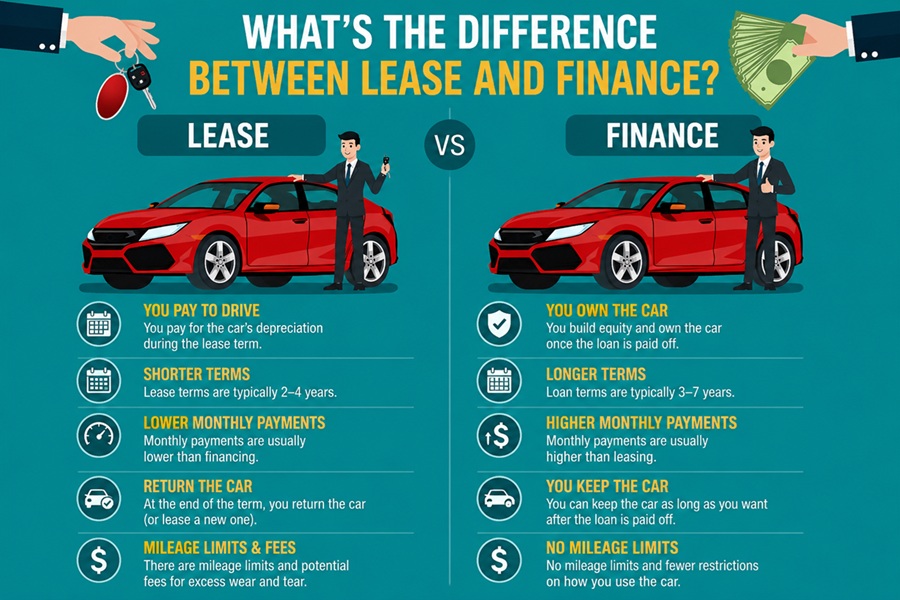
The core difference is ownership. When you finance a car, you take out a loan to buy it, and once the loan is repaid the vehicle is yours to keep. When you lease, you are essentially renting the car for a set period, making payments for the use of it, then returning it at the end of the term unless you choose to buy it out.
That single distinction drives everything else. Leasing usually means lower monthly payments but no asset at the end, while financing means higher payments that eventually leave you owning something of value. Neither is universally better. The right choice depends on how you drive, how long you keep vehicles, and what you want your money to buy.
| Comparison | Leasing versus financing |
| Category | Auto and personal finance |
| Financing means | Borrowing to buy and eventually own |
| Leasing means | Paying to use for a fixed term |
| Typical lease length | Around two to four years |
| Typical loan length | Around three to seven years |
| Ownership at end | Yours with financing, returned with leasing |
| Mileage limits | Common with leases, none when financing |
| Best for | Depends on driving habits and priorities |
How Financing Works
Financing is straightforward borrowing. A lender pays for the car, and you repay them over an agreed term with interest. You own the vehicle from day one, though the lender holds a claim on it until the loan is cleared.
Once you make the final payment, the car is entirely yours. You can keep it for as long as it runs, sell it whenever you like, modify it freely, and drive as many miles as you want. That freedom and the eventual asset are the main attractions.
How Leasing Works
A lease is closer to a long-term rental. You pay for the vehicle’s depreciation during the period you use it, plus fees and interest, rather than paying for the whole car. Because you are only covering part of its value, monthly payments tend to be lower.
At the end of the term you hand the car back, subject to conditions on mileage and condition. Many leases offer the option to buy the vehicle at a predetermined price if you have grown attached to it, though that is a separate decision.
Side-by-Side Comparison
Seeing the two arrangements next to each other makes the trade-offs obvious. Each column has genuine advantages depending on what you value most.
| Factor | Financing | Leasing |
| Ownership | Yes, once repaid | No, unless bought out |
| Monthly payment | Higher | Lower |
| Upfront cost | Often a larger deposit | Often smaller |
| Mileage limits | None | Usually capped |
| Customisation | Allowed | Restricted |
| End of term | You keep the car | Return or buy it |
| Long-term cost | Lower if kept for years | Higher if repeated |
| Repair risk | Yours after warranty | Often under warranty |
The Cost Question
Leasing looks cheaper month to month, and it genuinely is. But the comparison changes over a longer horizon. If you finance a car and keep it for several years after the loan ends, you enjoy years of payment-free driving that a leaser never gets.
Continuous leasing, by contrast, means a permanent monthly payment with nothing to show at the end. For drivers who keep cars a long time, financing usually wins on total cost. For those who change vehicles every few years anyway, leasing can be competitive.
Mileage and Condition Rules
One of the most important practical differences is the restrictions attached to a lease. Because the leasing company plans to resell the vehicle, they cap how far you can drive and expect it returned in reasonable condition.
Exceeding the mileage allowance triggers per-mile charges that add up quickly, and excessive wear can bring additional fees at return. If you drive long distances or are hard on vehicles, these costs can erase the savings from lower monthly payments.
- Annual mileage caps with charges for going over
- Wear and tear standards assessed on return
- Limits on modifications and customisation
- Fees for ending the lease early
When Financing Makes More Sense
Financing suits people who want the car to eventually be theirs and who plan to keep it well beyond the loan term. It also fits anyone whose driving does not fit neatly inside a mileage cap.
- You plan to keep the vehicle for many years
- You drive high mileage annually
- You want to build equity rather than pay for use
- You want freedom to modify or sell whenever you like
- You prefer no payments once the loan is finished
When Leasing Makes More Sense
Leasing appeals to drivers who like having a newer car, value lower monthly costs, and do not mind never owning the vehicle. It can also simplify life, since leased cars are typically under warranty for the whole term.
- You want a new car every few years
- You prefer lower monthly payments
- Your annual mileage is predictable and modest
- You would rather avoid resale and depreciation worries
- You want most repairs covered under warranty
What Happens at the End
The end of the term is where the two paths diverge most sharply. Financing concludes with you owning an asset outright, free to keep driving it without payments or to sell it and recover some value.
A lease ends with a decision. You can return the car and walk away, start a new lease on a different vehicle, or buy the car at the agreed residual price. Each option is valid, but none of them leaves you with an asset you have already paid off.
| End of Financing | End of Lease |
| You own the car outright | You return the car |
| No further payments | Payments continue if you re-lease |
| Free to sell for value | No resale value to you |
| Keep driving indefinitely | Option to buy at set price |
Understanding Depreciation
Depreciation sits at the heart of why these two options differ so much in cost. Cars lose value over time, and someone always absorbs that loss. When you finance, you absorb it yourself, but you also keep whatever value remains at the end.
When you lease, you pay for the depreciation that occurs during your term without carrying the risk of what the car is worth afterwards. That can be reassuring, since you never worry about resale value. The trade-off is that you also never benefit from any value the car retains.
Insurance and Ongoing Costs
The differences extend beyond the monthly payment. Leased vehicles often require higher levels of insurance coverage because the leasing company wants its asset protected, which can raise your premiums compared to a financed car.
Maintenance works differently too. Leased cars typically stay within the manufacturer warranty for the whole term, so major repair bills are rare. A financed car eventually falls outside warranty, meaning you take on repair costs, though by then you may also have no monthly payment to make.
- Leases may require higher insurance coverage levels
- Leased cars usually stay under warranty throughout
- Financed cars need repair budgeting after warranty ends
- Both require routine servicing to stay in good condition
Business and Tax Considerations
For some drivers, particularly the self-employed or business owners, tax treatment influences the decision. Lease payments and vehicle expenses may be handled differently for business purposes than the cost of purchasing a vehicle outright.
These rules vary considerably by location and by how the vehicle is used, so it is worth speaking to an accountant if the car serves a business purpose. What looks like the cheaper option for a personal driver may not be the same for a business.
Making the Right Choice
The best way to decide is to be honest about your habits rather than chasing the lowest monthly figure. Ask how long you typically keep a car, how many miles you drive, and whether owning an asset matters to you.
If you keep cars until they wear out and drive plenty of miles, financing almost certainly serves you better. If you enjoy driving something new every few years and stay within modest mileage, leasing can be a reasonable fit. There is no universally correct answer, only the one that matches how you actually live.
Frequently Asked Questions
What is the main difference between leasing and financing?
Financing means borrowing to buy the car so you eventually own it, while leasing means paying to use it for a fixed term before returning it.
Is leasing cheaper than financing?
Monthly payments are usually lower with a lease, but financing often costs less over the long run because you end up owning the vehicle outright.
Can you buy a car at the end of a lease?
Often yes. Many leases include an option to purchase the vehicle at a predetermined price when the term ends.
What happens if you exceed lease mileage limits?
You are charged a fee for each mile over the agreed allowance, which can become expensive if you significantly exceed the cap.
Which is better for high-mileage drivers?
Financing, since there are no mileage restrictions and the excess mileage charges on a lease can quickly outweigh its lower monthly payments.